Posts

Showing posts with the label #Hubble

NASA Discovers Very Valuable Asteroid

Image
 Metal Asteroid Valued at $10,000,000,000,000,000,000                                                        Source:   NASA Psyche Spacecraft Artist Rendering 16 Psyche Asteroid NASA just struck gold!  NASA's Hubble Space Telescope has discovered a rare, heavy and tremendously valuable asteroid called "16 Psyche".  The metal asteroid is located between Jupiter and Mars in the Solar system's main asteroid belt.  It's about the size of West Virginia and is 230 million miles from Earth.  Unlike most asteroids that are rocky or icy, 16 Psyche is almost entirely metal. The research team that made the discovery thinks it may be made of iron and nickel.  Given its size and metal content, 16 Psyche is valued by experts at $10,000,000,000,000,000,000.  That is 10,000 times more valuable th...

Brightest Star of All in Universe

Image
Supernova 5Billion Times Brighter Than the Sun                                 Source:  ESA Hubble & NASA Photo Photo From Hubble Telescope Before It Faded Away The Hubble Telescope captured images of one of the most spectacular light shows in the universe ever seen.  It was a supernova that outshone every star in its galaxy.  The supernova, called SN2018GV, put on a gorgeous showing with the radiance of 5 billion suns before it gradually started fading away.  Fortunately for us, it was caught in a series of images by the Hubble Telescope, operated by the European Space Agency (ESA) and NASA.  The supernova was first spotted by Hubble in January 2018, 70 million light years from Earth.  Binary Star SN2018GV was a binary dwarf star that was pulling in matter from its companion star.  In space, once a star starts pulling in matter from its companion equal t...

STUNNING STAR FIREWORKS

Image
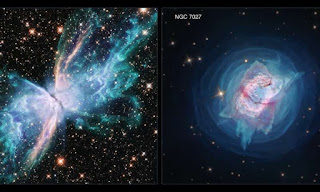
Hubble Space Telescope Images Source:  Hubble Space Telescope  "Two Stars Going Haywire" The NASA/ESA Hubble Space Telescope has just captured new images of two nearby stars putting on a spectacular fireworks display in outer space.  They are two planetary nebulae named the Butterfly nebula and NGC 7027.  Astronomers say they are highly unusual, among the dustiest planetary nebulae ever discovered and contain unusually large amounts of gas. Nuclear Fusion Stars are engines of nuclear fusion.  They live peaceful lives for billions of years.  But near the end of their lives the fireworks start with erupting jets of hot gas from them exploding into the universe.  Astronomers say the complexity and rapid changes in the jets of gas shooting off these two stars is unprecedented.  The new Hubble images demonstrate that the two stars are splitting themselves apart in a very short timeframe. Unprecedented Access Hubble is providing astronomers...

AMAZING LOOK AT JUPITER's STRONG STORMS

Image
Amazing Look at Jupiter's Strong Storms with NASA Tech Source:  NASA Jupiter Thunderstorms Place in the Universe Where the Weather is Never Pleasant The image is one of the highest resolution, infrared views of the Planet Jupiter ever taken.  And, the view is simply  amazing.  Jupiter is lite up in huge thunder storms. This image is the result of the most highly advanced  space technology and the scientists behind it teaming up.  NASA's  Hubble Space Telescope, the Gemini Observatory in Hawaii and the Juno spacecraft came together to explore the fiercest storms in the solar system.  The location of some of the Universe's worst  weather is Jupiter, more than 500 million miles from Earth. It appears weather is never pleasant there. Stormy Weather A team of researchers led by U-CAL Berkeley's Michael Wong are using the images coming in to learn how Jupiter's turbulent atmosphere and weather work.  Storms are constant on Jupit...

New Discoveries for the Hubble Telescope

Image
Hubble Turns 30 Source:  NASA, ESA Hubble Space Missions Ahead The Hubble Telescope has been  exploring and discovering new worlds in space for thirty years.  It was deployed in space on April 25, 1990. More than anything else, it has showed mankind the Universe around us. Early Years The first few years of its space tour of duty were riddled with technical problems, particularly with its mirrors.  But new technology and new cameras were launched and deployed by astronauts on Hubble. Hubble Field By 1994, it began its riskiest and richest mission - the Hubble Field.  For ten days scientists used Hubble to examine what seemed like a dark spot in the Universe. No signs of any brightness, probably no stars. What Hubble found were thousands of distant stars and  galaxies.  Those findings,  back in 1994, have forever changed our view of the Universe, as an immense world of discovery. What's Next...

Pink Cloud of Baby Stars

Image
NASA's Hubble Space Telescope Discovery Source:  NASA's Hubble A Star is Born The Hubble Space Telescope has just discovered and provided spectacular images of a dazzling pink cloud that is a birthplace in the universe for massive stars.  The cloud is known as LHA 120-n 150.  It's a cloud of dust and gas surrounded by sparkling young stars.  You might call it a "space nursery" for baby stars. Distant Views into Space. The pink cloud is located near the Tarantula Nebula, which is a known hot spot for star formation.  The images that Hubble is now providing to astronomers will help them learn how massive stars are created.  Astronomers' theoretical models indicate that massive stars should form within clusters.  But astronomers are now learning through observation that at least 10% of massive stars form in isolation in space. Time Tunnel into the Past Hubble is a joint project between NASA and the European Space Agency.  Ei...

Massive Space Tsunamis

Image
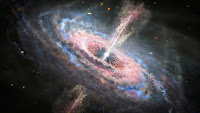
New NASA Discovery - Quasars Erupting with Energy Outflows Source:  Hubble image of quasar tsunami Energy Outflows Accelerating at 46 Million Miles Per Hour NASA's Hubble space telescope has spotted tsunamis ripping across galaxies in deep space.  The tsunamis spotted by NASA astronomers are actually quasar tsunamis.  Quasars are objects similar to stars in distant space.  NASA just unveiled the discovery.  They are calling it "the most energetic outflow ever witnessed in the Universe." 13 Quasar Outflows Spotted The outflows from the quasars tear across interstellar space causing massive havoc to the galaxies where the quasars reside. The amount of energy is tremendous.  And the velocities of the quasars is unfathomable - 46 million miles per hour, or as NASA puts it a few percentages of the speed of light. NASA was able to study 13 quasar outflows and also measure the speed of the gas spewing out of them being accelerated by the qua...

Space Particle From 14 Billion Years Ago

Image
Is This the Universe's Dark Matter? Source:  European Space Agency/Hubble Big Bang Subatomic Particle Researchers believe that they have identified a subatomic particle that may have formed the Universe's dark matter right after the Big Bang, nearly 14 billion years ago.  They say this is one of the strongest pieces of evidence of the very existence of dark matter.  Dark matter can be seen in the picture (above) floating like a ring in the galaxy cluster ZwC10024+1652.  The team of astronomers, studying images obtained from the Hubble telescope, believe that dark matter was produced by a collision between two huge space clusters. Dark Matter Scientists have estimated that 27% of the matter in the Universe could be dark matter.  There has been very little substantive understanding of what dark matter is until now.  A team of nuclear physicists think that dark matter could be made from the newly identified particle - the d-star hexaquark. Quarks...