Posts

Showing posts with the label #stars

STUNNING STAR FIREWORKS
Image
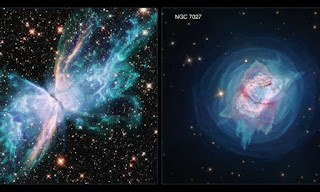
Hubble Space Telescope Images Source:  Hubble Space Telescope  "Two Stars Going Haywire" The NASA/ESA Hubble Space Telescope has just captured new images of two nearby stars putting on a spectacular fireworks display in outer space.  They are two planetary nebulae named the Butterfly nebula and NGC 7027.  Astronomers say they are highly unusual, among the dustiest planetary nebulae ever discovered and contain unusually large amounts of gas. Nuclear Fusion Stars are engines of nuclear fusion.  They live peaceful lives for billions of years.  But near the end of their lives the fireworks start with erupting jets of hot gas from them exploding into the universe.  Astronomers say the complexity and rapid changes in the jets of gas shooting off these two stars is unprecedented.  The new Hubble images demonstrate that the two stars are splitting themselves apart in a very short timeframe. Unprecedented Access Hubble is providing astronomers...
SPACE 2020's: WHAT'S UP THERE?

Image
Amazon Book Promotion Source:  Amazon Special Deep Discount for a Limited Time I'm pleased to announce that Kindle and Amazon are beginning a promotion on my book "SPACE 2020's: WHAT'S UP THERE?" Starting May 27 through May 30, the book goes on sale for $3.99. That is a deep discount off the regular price of $6.99.  And, on May 31 through June 2 8AM PDT, it will be selling for $4.99. It then returns to its regular price of $6.99 Great Deals on a Great Resource If you enjoy learning about WHAT'S UP THERE? in space, you'll love the book and find it a great resource on the top space missions and very recent space discoveries of the 2020's.  Here's a link for access to the book  ASIN: B087DV4DZ6 And for access to my Amazon Author's Page, click here   amazon.com/author/ekane ... ...

DISCOVERY OF CLOSEST BLACK HOLE TO EARTH

Image
Circling Stars Gave It Away to Astronomers Source:  European Space Agency A Black Hole "In Our Neighborhood" European astronomers have found the closest black hole to Earth ever discovered.  It is so close that two stars circling it can be seen with the naked eye.  The black hole is called the HR 6819 triple system.  It was created by the death of a fleeting young star.  Two remaining super hot stars continue to orbit it. Trillions of Miles From Earth It is the closest black hole discovered but it is still 1,000 light years away.  Every light year equals 5.9 trillion miles.  It was discovered by astronomers using the European Space Agency's massively powerful telescope at the European Southern Observatory in northern Chile.  Lead astronomer Thomas Rivinius says the black hole "is in our neighborhood".  He adds there may be 100 million to one billion of these relatively small but hugely dense objects in the Milky Way. Black Holes...

Space 2020's: What's Up There? by Edward Kane

Image
Fascinating New Book on the Latest Space Discoveries Travel to New Worlds Just Discovered in Space My latest book "Space 2020's: What's Up There?" has just been published on Amazon and Kindle as an e-book ASIN: B087DV4DZ6 and paperback   ASIN: B087FFM5B7 Fascinating Journeys The book is a journey to exciting and mysterious new worlds just discovered by NASA, the European Space Agency and global astronomers with  powerful space. telescopes. Space Vacations The book details exotic planets that rain diamonds, Earth-like planets that may contain extraterrestrial life, baby stars being born, massive exploding supernovas, black holes, black matter and much more.  Reading the book is like a vacation in space.   amazon.com/author/ekane ... ...

Pink Cloud of Baby Stars

Image
NASA's Hubble Space Telescope Discovery Source:  NASA's Hubble A Star is Born The Hubble Space Telescope has just discovered and provided spectacular images of a dazzling pink cloud that is a birthplace in the universe for massive stars.  The cloud is known as LHA 120-n 150.  It's a cloud of dust and gas surrounded by sparkling young stars.  You might call it a "space nursery" for baby stars. Distant Views into Space. The pink cloud is located near the Tarantula Nebula, which is a known hot spot for star formation.  The images that Hubble is now providing to astronomers will help them learn how massive stars are created.  Astronomers' theoretical models indicate that massive stars should form within clusters.  But astronomers are now learning through observation that at least 10% of massive stars form in isolation in space. Time Tunnel into the Past Hubble is a joint project between NASA and the European Space Agency.  Ei...

Snowman Star Born From 2 Stars Merging

Image
UK Scientists Discover Two Merging Stars Shaped Like a Snowman - New Star Source:  Warwick University, UK Unique Shape and Unique Atmosphere Composition Nothing like this new star has ever been discovered in space before.  Warwick University scientists have spotted a huge, snowman-shaped star. It's a new star just born by the merger of two "white dwarf" stars.  They've named the star WDJ0551+4135.  The star's atmosphere is unique and unusually rich in carbon.  Everything about this star has the potential of leading to new scientific discoveries about the universe and the birth and death of stars. Bigger Than the Sun The new Snowman star is more massive than the Sun.  Another unusual aspect of the birth of this star is that the merger of the two "white Dwarf" stars didn't result in an explosion and powerful supernova.  The Warwick University scientists say what is particularly exciting for their research is that the stars merge...

Out of This World Exoplanet

Image
Out of This World Exoplanet Source:  NASA Artist Rendering Exoplanet LHS 3844b A NASA space telescope has revealed for the first time a rocky Earth-sized exoplanet.  It's outside of our solar system and tightly orbits around  the most common type of star in our home galaxy, the Milky Way.  The exoplanet has no atmosphere to sustain life. Atmospheric Void Researchers  published their discovery in the journal Nature.  They say the surface of the exoplanet, known as LHS 3844b, is most likely barren like the Moon or covered in dark volcanic rock.  The exoplanet is 49 light years away from the  Earth.  It's one of 4000 exoplanets, discovered in the past 20 years, that orbit stars in the Milky Way.  It's 1.3 times larger than the planet Earth.  

NASA 21 Whole New Worlds

Image
NASA Spacecraft TESS Discoveries Source:  NASA Planet Hunter Extraordinary NASA's planet hunter TESS spacecraft - Transiting Exoplanet Survey Satellite - has just marked its first year in space and the results are extraordinary.  The spacecraft has discovered 21 new worlds outside of our solar system.  It's also spotted 850 possible exoplanets that just have to be confirmed and 6 supernovas.  For NASA the results are way beyond all expectations. Star Search TESS is focusing on stars that are less than 300 light years away.  It looks for dips in brightness which indicates that an object just passed across the star.  The data will help NASA determine which exoplanets it wants to explore in-depth and where life might exist. Historic Mission This is the most comprehensive search for planets ever accomplished by mankind.  TESS just finished exploring the southern part of the sky and will now start examining the north.  For a free Kindle ...